

Sequencing, Not the Transfer Amount, Decides Whether Decentralization Diffuses.
National capacity does not diffuse itself. Colombia's transfer reform suggests sequencing decides whether decentralization diffuses or entrenches.

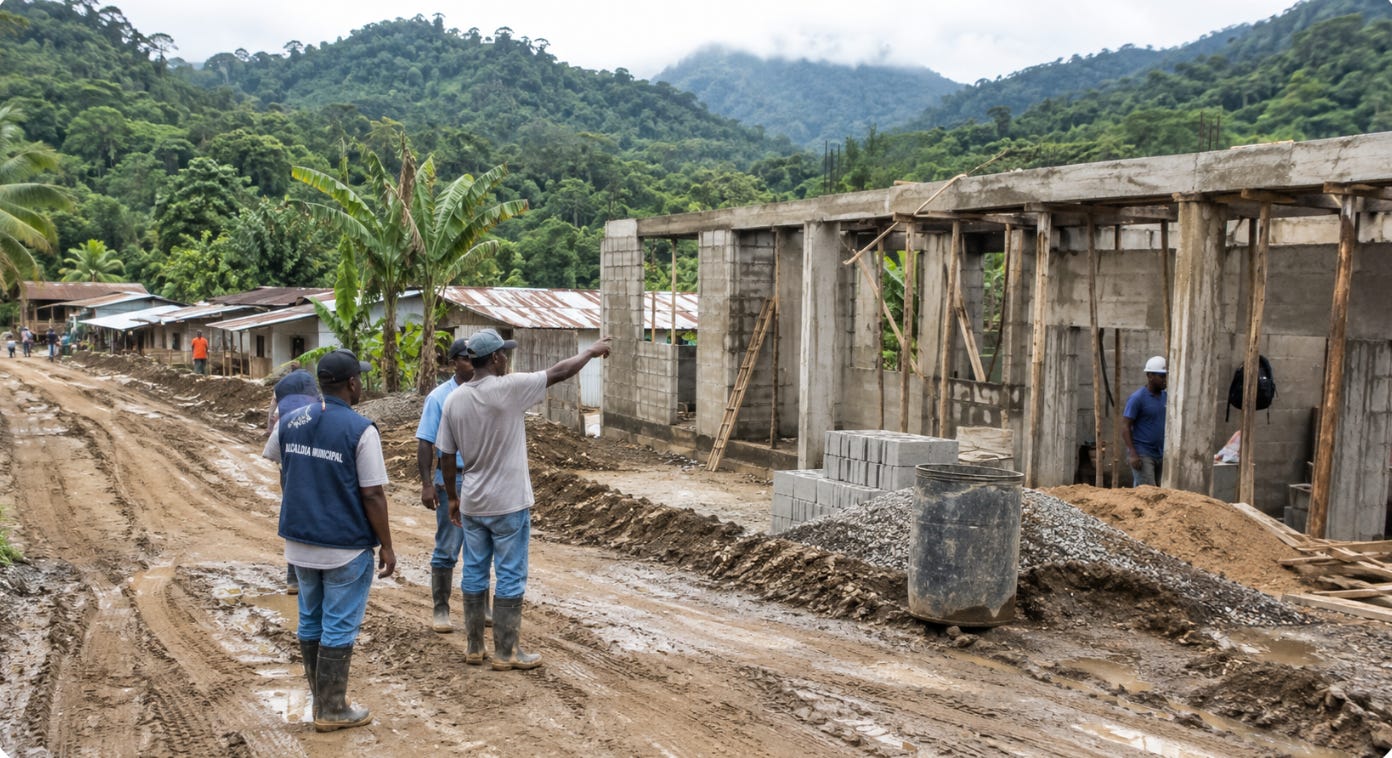
Colombia is about to double the money it sends to its departments. In December 2024, Congress passed Legislative Act 018, rebuilding the General System of Participation (SGP). Transfers rise from 20.8% of national current revenue to 39.5% by 2035-36, phased over 12 years starting in 2026. In GDP terms, that is 5.1% climbing toward 6.8%. It is the largest expansion of intergovernmental transfers since the 1991 Constitution. However, the last expansion did not redraw the map. The six departmental economies anchored by Bogotá, Medellín, and Cali accounted for 67.1% of national GDP in 2024; they have accounted for roughly two-thirds of national GDP since the 1990s. The Competencies Law, which assigns functions to each level of government, was due in July 2025; it is still sitting in committee. The new reform forces one question: do the remaining 26 other departments – the interior - have the capacity to absorb the additional money, or will the triangle absorb it instead?
This series of essays has viewed the state as a national unit: capability, delivery, and diffusion, all at the national scale. An earlier essay concluded that national delivery capacity is necessary but not sufficient, then noted that subnational execution varies in quality. That essay did not dig deeper; this one does. It drops the lens below the national government in Colombia, where thirty-two departments turn one formula into thirty-two outcomes. This essay sets out three propositions. First, enclaves form by market selection, while diffusion must be built. Second, no Latin American case shows transfers diffusing growth without prior subnational capacity. Third, sequencing -- capacity before money -- decides whether decentralization diffuses or entrenches. It states that perspective, tests it in Colombia against several comparators, answers the strongest objections, and asks what Colombia can do now.
Enclaves form by selection; diffusion must be built.
The three mechanisms underlying this essay come from an evolutionary economics perspective: variation, selection, and diffusion. Colombian departments vary in productive structure, from export-crop agriculture and light manufacturing to port logistics and subsistence farming. Then markets select the more successful productive structures. Investors reinforce sites already proven productive, and concentration compounds across generations. Colonial-era endowments still predict departmental income today, and this effect remains significant after controlling for transfers, infrastructure, and national policy. That is path dependence, two centuries deep.
Diffusion is different. Perroux’s (1955) growth-pole theory never settled the question of whether a pole spreads growth or pulls resources back toward itself. It depends on conditions. Advantage diffuses where subnational coordinating capacity precedes the money flows. Where that capacity is absent, transfers raise spending without raising productivity, so the old pattern entrenches.
The selection evidence is specific. Sectoral composition, not transfer receipts, separated the departments that grew from those that stagnated. The diffusion constraint therefore sits below the national level, at the departmental and municipal levels of execution. That is the main point of this essay: in any country there is one national government, but there are many regional entities and municipalities (thirty-two departments in Colombia), and therefore a within-country variance that a national lens cannot see.
The Colombia triangle held its share as transfers rose.
The SGP dates from the 1991 Constitution (Articles 356-357) and was operationalized by Law 715 of 2001. It earmarked a share of current national revenue for education, health, and potable water. Transfers rose from about 2% of GDP in 1990 to 4.6% by 2003. The money bought a catch-up, then a reversal. The poorer departments grew faster than the wealthy core, closing the income gap by roughly 1.61% a year from 1990 to 2012. Even so, the spread of incomes across departments narrowed only until the mid-2000s; then it began widening again.
The key actors are clear. Congress wrote the formula, the National Planning Department (DNP) administers it, and the national treasury pays. Thirty-two departments and 1,123 municipalities execute. The weakest quartile of municipalities, concentrated in Amazonia, Choco, and the Pacific coast, under-executes capital budgets even when the transfers flow. Colombia’s under-execution is documented qualitatively, whereas Peru’s decentralized execution challenges are documented quantitatively. In Peru, between 2010 and 2020, the average share of mining canon funds executed by sub-nationals was 70%; by 2020, 95% was being executed, suggesting that capacity was built over time. In Colombia, the core transformed: Bogotá produced about US$105.6 billion in output in 2024, Antioquia about US$62.2 billion, and Valle del Cauca about US$40.9 billion. That output spans diversified services, manufacturing, and logistics. But the periphery neither converged nor changed its productive structure.
No LAC case shows money diffusing growth without building prior capacity.
Every case that I looked at in LAC confirms that growth is not diffused in decentralization without prior capacity building: Colombia, Venezuela’s Ciudad Guayana, Brazil’s SUDENE, Peru, and Trinidad. The argument would fail if a Latin American case showed that a designated pole or corridor produced broad territorial convergence without prior subnational capacity.
Chile shows the capacity-first order. CORFO built export clusters where no prior agro-export capacity existed: salmon in Los Lagos, fruit in Atacama and O’Higgins, and wine in Maule. But CORFO first built sector-specific state capacity, and firms followed.
Guyana’s Norway Agreement moved US$212.6 million toward forest communities between 2009 and 2015 without prior subnational capacity. The sum is small compared with the present LCDS funds and the oil funds, but no real hinterland productive capacity outcome has been documented.
Where capacity is thinnest, delivery fails first.
Colombia’s SGP is a recurrent, earmarked formula transfer. Peru’s mining canon is a derivation-based revenue share paid to producing territories. Guyana’s Natural Resource Fund (NRF) and Trinidad’s Heritage and Stabilisation Fund are national sovereign funds with no derivation-based subnational share. Thus, different kinds of national balance sheets carry different diffusion logics. Venezuela’s Guayana Corporation (CVG) planted a steel city on the Orinoco in the 1960s. Once built, it became a state-owned enclave with thin backward linkages. SUDENE in Brazil, designed by Celso Furtado in 1959, built technocratic capacity within the agency rather than in subnational governments. Cardoso abolished it in 2001; Lula recreated it in 2003. The Northeast narrowed income gaps with the rest of Brazil during the 2000s – but the main driver does not appear to be SUDENE, but rather cash transfers and access to finance for small farmers and businesses.
Trinidad shows the sovereign-fund failure mode. Energy tax revenues fell from 18.4% of GDP in FY2007/08 to 12.9% in FY2013/14. Between 1999 and 2015, the state collected about US$45.1 billion and spent about US$45.0 billion on transfers and subsidies. The rents were consumed hand to mouth, so the enclave re-entrenched.
Guyana is the live small-state case. The NRF reached US$3,594.22 million in September 2025, with cumulative withdrawals of US$4,595.78 million. The 2025 budget, at about US$6.5 billion, was the largest in the country’s history. The 2026 national budget is about US$7.5 billion. The sovereign wealth fund has no derivation-based subnational channel, so reach beyond Georgetown into the hinterland depends entirely on discretionary national spending. But the regional tier shows the strain. The Auditor General’s report for 2024, laid in Parliament in late 2025, found contract overpayments in nine of the country’s ten Regional Democratic Councils—weak financial control across nearly every region, exactly where the money would have to land. Across all four cases, delivery will land where subnational capacity exists—the Colombia SGP pattern, exactly.
The strongest objections point at real gains, but not at diffused growth.
First, the AFD evaluation of Colombia records service-delivery gains in lagging municipalities, which suggests capacity can be built in place. But the evaluation tracked school coverage and health visits—services delivered, not productive growth. Building a service-delivery system is not building the productive absorption that diffusion requires. Second, Peru shows the sequence can be repaired mid-stream: the share of mining canon executed by sub-nationals rose from about 70% over 2010-2020 to 95% by 2020. But the repair cost a decade of 70% execution and heavy capacity building, which confirms the constraint rather than dissolving it. Third, Brazil’s Northeast narrowed its income gap with the rest of the country during the 2000s without building subnational governmental capacity—the closest thing to a falsifying case. But the driver was cash transfers and access to finance for small farmers and firms, not SUDENE; distribution narrowed while the productive structure did not transform.
The 1991 Colombian reform raised the money but has not assigned the functions.
The 1991 Colombian Constitution set the direction; Law 715 of 2001 and Legislative Act 018 of 2024 renewed it. Yet coherence failed at the join between the reform’s two instruments. The constitutional amendment raises the money on a twelve-year schedule, while the Competencies Law assigning functions remains unwritten—direction without assignment—a failure of execution.
The SGP shapes service markets -- education, health, water -- and leaves production untouched. However, Chile’s CORFO directly shaped production: sector agencies and credit lines preceded the salmon, fruit, and wine firms. There does not appear to be a similar production-shaping instrument for Colombia’s periphery.
SGP transfers totaled about US$17.3 billion in 2024. Education transfers alone ran about US$7.1 billion, or 1.8% of GDP, in 2023. The reform path climbs from about US$21.3 billion in 2026 to about US$41.1 billion by 2034.
The DNP administers the formula, the treasury pays, and 1,123 municipalities execute. Yet the mechanism jams in execution. Low administrative-index municipalities under-execute capital budgets even when transfers flow.
Colombia’s Monitoring, Follow-Up, and Control Strategy, the adaptive instrument the AFD evaluation credits, tracks service delivery, not productivity or growth.
Sequencing decides the outcome, not the transfer amount.
The main constraint on developing beyond enclaves is departmental and municipal absorptive capacity, which is measurable. Where autonomy and capacity exist, growth follows. In Colombia, when a region controls 10 percentage points more of its own budget, its long-run growth rate is about a quarter of a percentage point higher (Lozano and Julio, 2016). Where administrative capacity is absent, budgets go unexecuted. Therefore, a reform that ignores this constraint distributes money without distributing capability. The lever the evidence supports is narrow: build execution capacity in the weakest quartile -- Amazonia, Choco, the Pacific -- before moving money.
Sequencing decides whether the constraint binds. Law 715 assumed administrative systems that did not exist uniformly; the money arrived before the institutions that could deploy it. CORFO ran the sequence in the other order: capacity first, then firms, then exports. Peru shows the sequence can be repaired mid-stream with heavy capacity building, but at the cost of a decade of 70% execution. Colombia’s Competencies Law is the same test, running now, and running late.
No phase-in schedule avoids both losses at once.
The trade-off is transferring speed against absorptive capacity. Move money faster than departmental capacity grows, and decentralization fragments rather than diffuses. Slow the phase-in, and the redistribution the reform promises is deferred, with political costs. No schedule avoids both losses; there is only an explicit choice between them. This is a sequencing rule, not about the level of transfers.
* * *
Colombia has already answered the sequencing question once, in 2001, and the interior paid for the answer. The 2024 reform re-runs the experiment at double scale. The Competencies Law deadline passed in July 2025 with the bill in committee, while transfers begin phasing in 2026. So, the money is moving before the rules are written. The remaining lever is narrow: enact the law, then front-load execution capacity in Amazonia, Choco, and the Pacific. The schedule climbs toward about US$41.1 billion by 2034; the weakest quartile must be ready before it peaks. The constraint named at the start -- absorptive capacity in the interior, not cash -- will decide the outcome. If the large tranches arrive before the law, departmental dispersion will widen again. The six departments will still hold two-thirds of the economy when the next reform is drafted.
Further reading.
Ignacio Lozano and Juan Manuel Julio, “Fiscal decentralization and economic growth in Colombia: evidence from regional-level panel data,” CEPAL Review No. 119 (August 2016), pp. 69-89.
Leopoldo Fergusson, Carlos Molina, James A. Robinson, and Juan F. Vargas, “The Long Shadow of the Past: Political Economy of Regional Inequality in Colombia,” RIMISP, 2017.
World Bank, “Regional Disparities and the Road to Integration: The Geography of Growth in Colombia,” World Bank, 2025.
Diego Fernando Ocampo, Lady Johana Rodriguez, and Mario David Chavez, “Assessing the Impact of the Monitoring, Follow-Up, and Control Strategy of Colombia’s General System of Participations,” Agence Française de Développement, 2025.
Tarrara Alves Horsth, Fernanda Maria de Almeida, and Wesley de Almeida Mendes, “Medidas institucionais e econômicas do PAC: A recriação da Sudam e da Sudene e o desenvolvimento regional,” Latin American Research Review, Vol. 56, No. 1 (2021).