

States transform when leadership functions cohere.
Latin American outcomes diverge through leadership.

Across Latin America, governments are pursuing ambitious opportunities. Chile is positioning itself around the Humboldt Cable and digital infrastructure. Brazil is testing the institutional implications of Pix, artificial intelligence, and digital public infrastructure. Plans are plentiful, capital is available, and technologies are advancing rapidly. Yet outcomes still diverge.
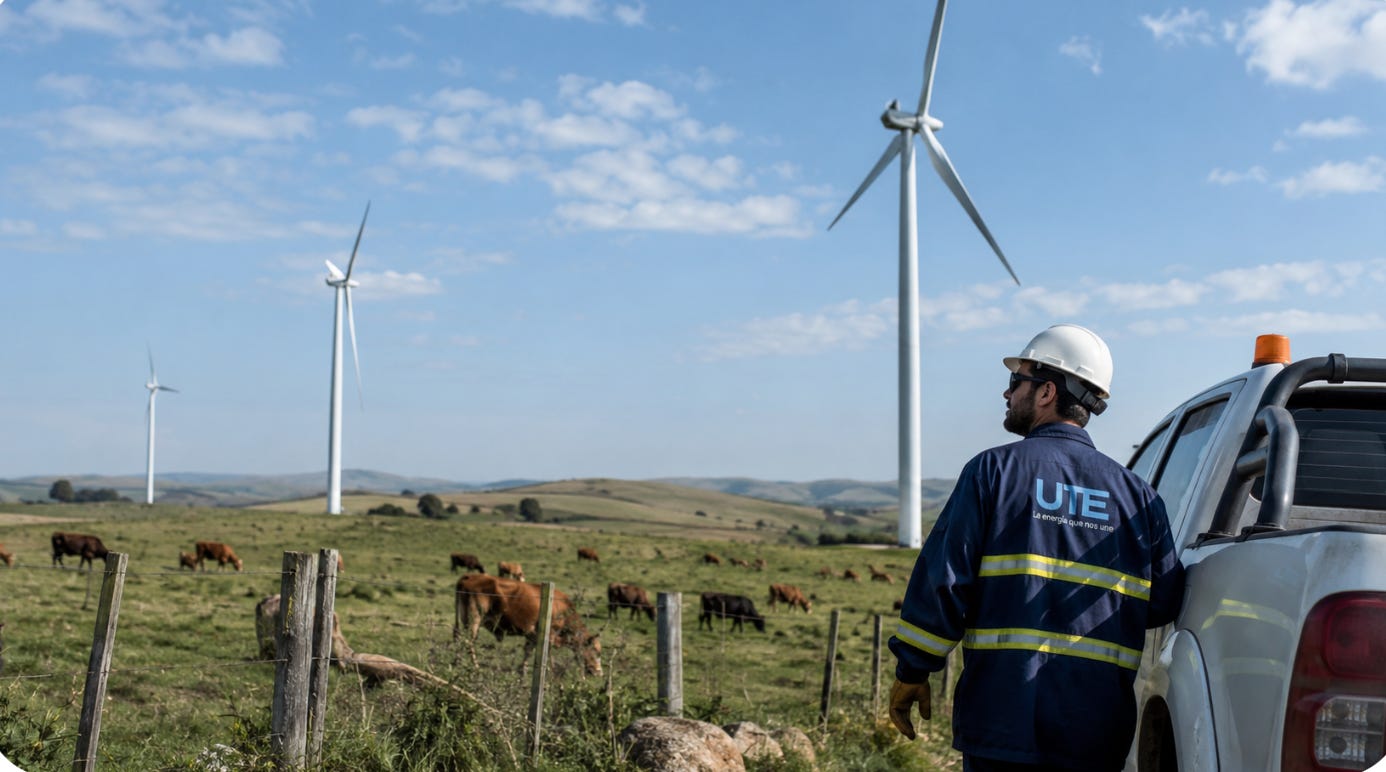
A decade ago, Uruguay’s energy transition looked like a small-country success story. The same electricity system that freed the country from reliance on imported fossil fuels is now being discussed as a platform for electrification, green hydrogen, and data-center investment.
Some countries convert opportunity into durable change, while others stall at announcements, pilot projects, and partial reforms. Governments do not lack ideas or resources. They lack the capacity to lead. Using Uruguay’s energy transition, this essay examines a specific configuration of strategic leadership - direction, alignment, and delivery - and shows how their combination helps explain divergent outcomes across Latin America.
Strategic leadership operates inside capable states.
Capacity becomes vague without mechanisms.
The language of state capacity often becomes too broad to explain anything well. Analysts expect capable states to plan, coordinate, regulate, finance, learn, and adapt. As a result, state capacity can become a label for success rather than an explanation of how success emerges.
This essay adapts the direction, alignment, and commitment (DAC) leadership ontology developed by Drath et al. (2008) to analyze state capacity. Drath et al. treat leadership as a property of collectives that produce direction, alignment, and commitment, not as a trait of individuals. A state pursuing transformation is exactly such a collective - ministries, firms, investors, and citizens - which is why the ontology transfers. It retains direction and alignment but replaces commitment with delivery. That change emphasizes the state’s ability to turn strategy into projects, investments, and operational outcomes. Direction defines where a country is trying to go. Alignment brings institutions, coalitions, and investors onto a common trajectory. Delivery turns strategic intent into implementation. Credibility is not a fourth function. It is the investor-facing edge of alignment - the means by which direction becomes commitments that private capital will price.
In Latin America, Chile’s long tradition of strategic planning illustrates direction, Uruguay’s energy pact illustrates alignment, and institutions such as the Chilean Economic Development Agency (CORFO), the Brazilian Development Bank (BNDES), and the Brazilian Agricultural Research Corporation (EMBRAPA) illustrate delivery through sustained organizational capability. CORFO financed Chile’s electricity, steel, and petroleum industries from 1939, a delivery capacity that outlasted the governments that created it.
This triad is a leadership subset of a broader state-capacity framework, not a separate theory of development. The broader framework includes market shaping, public spending and services, private sector coordination and capital mobilization, and learning and adaptive management. In practice, institutions such as CORFO in Chile, BNDES and EMBRAPA in Brazil, and Uruguay’s national utility, Usinas y Transmisiones Eléctricas (UTE), carry these functions. The triad, therefore, works through the broader institutions that deliver these functions rather than replacing them.
This essay describes a potential diagnostic vocabulary, not a causal law. It does not claim that adding one function produces a transformation, or that all three together predict success better than rival explanations. It offers a way to read why some configurations hold together and others break apart.
Regional failures expose recurring weak links.
Viewed this way, three recurring pathologies appear across the region. Some states develop ambitious visions and broad political support but fail to build institutions capable of executing them. Colombia’s slow and uneven peace implementation and Peru’s difficulty converting resource-led growth into coordinated territorial development illustrate this pattern. Other states build capable agencies and delivery mechanisms but lack a coherent long-term direction. In nitrate-era Chile, effective revenue extraction did not generate a broader process of capability building. Argentina reached the same outcome through instability rather than absence: repeated reversals of economic strategy left even capable agencies without a stable direction to execute. Still other states maintain administrative routines without strategic direction or durable alignment. In Venezuela’s rent-centered political economy and Honduras’s enclave model, institutions focused more on maintenance and reinforcement than change.
Evolutionary economics offers a useful complement. Institutions are not built in a single act of design. They emerge through variation, selection, and diffusion across critical junctures. Successful arrangements gain reinforcement through learning and political support. Failed arrangements are modified or abandoned. Chile’s salmon industry shows the risks of skipping some learning from Norway: output scaled faster than regulation through the 1990s, until the 2008 ISA virus outbreak collapsed production. Path dependence helps explain why certain capabilities tend to move together. States rarely acquire direction, alignment, and delivery independently. More often, reforms, crises, bargains, and experiments build them in sequence.
The comparative pattern is descriptive rather than deterministic. In stronger cases, all three functions are present. In weaker cases, at least one is weak or absent. The missing function is usually alignment. Many countries had plans. Fewer built durable coalitions that coordinated institutions, investors, firms, and citizens over time. This claim can fail, and that is what makes it useful. A state with clear direction and capable delivery but no durable coalition should stall short of transformation. A case that broke that pattern would sink the argument.
Comparative evidence from Chile, Brazil, Costa Rica, Peru, and Venezuela suggests that this triad is not unique to Uruguay. Costa Rica is the clearest parallel. Since 1949, it has anchored development in social investment and clean electricity, held that course through a broad social compact, and built out renewable capacity decade by decade - direction, alignment, and delivery reinforcing one another long before Uruguay’s transition. Barbados is the newer test: it has set a clear direction - 100% renewable power and carbon neutrality by 2030 - but whether alignment and delivery follow is still unfolding. Barbados is the honest test of the framework. Uruguay and Costa Rica are cases already known to have succeeded, and a model built to explain them risks fitting itself to the outcome. The argument earns its keep on the cases still in motion, not the ones already settled. What varies is not the presence of plans, institutions, or capital, but the degree to which direction, alignment, and delivery reinforce one another over time. Uruguay is analytically useful because the sequence is unusually visible. Strategy was defined, investors and parties were aligned, and delivery followed from their interaction.
Uruguay built the triad sequentially.
Successful transformations occur when direction, alignment, and delivery operate together. Uruguay’s energy transition suggests that these functions were not built at once. They emerged in sequence.
The critical juncture arrived in 2008. A severe drought sharply reduced hydropower output, while international oil prices approached historic highs. A country that depended heavily on imported energy suddenly faced the economic and strategic costs of that dependence. What looked like an energy problem quickly became a national development problem.
The response began with direction. Policymakers reframed energy policy around sovereignty and long-term energy security. They aimed beyond renewable generation, redefining the country’s development trajectory around a more secure and predictable energy system.
Credibility aligned the investors behind the strategy.
The next step was credibility. Between 2008 and 2012, Uruguay established long-term, dollar-denominated power-purchase agreements. This design shifted much of the upfront capital burden onto private firms while giving investors stable revenue streams through fixed-rate contracts lasting 20 years. UTE is committed to purchasing electricity under these agreements. That commitment reduced uncertainty and created investable projects.
The results were substantial. Uruguay XXI reports about US$7.8 billion in investment mobilized between 2010 and 2016, while broader government and industry estimates place cumulative investment above US$8 billion. The critical point is not the precise figure but the mechanism. Private capital flowed because long-term credibility turned strategic intent into investable opportunities. Chile built the same credibility by a different route: its 2001 structural fiscal rule made policy predictable and reassured investors without relying on any single flagship contract.
The multiparty pact made alignment durable.
Alignment, however, became the keystone.
In 2010, Uruguay’s political parties signed the Multiparty Energy Agreement. The agreement established a shared framework for institutional development, energy demand and supply, and the social dimensions of the transition. More importantly, it lifted energy policy above the normal cycle of partisan competition. Uruguay made this easier than most: a small polity, a consensual political culture, and proportional representation that forces parties to bargain. Where those conditions are absent - in Brazil’s fragmented congress or Argentina’s polarized cycles - a comparable pact is harder to strike, and the lesson travels less cleanly.
In the region's history, these kinds of agreements have mattered because many reforms survive only as long as the government that creates them. Uruguay’s energy pact did something different. It persisted across successive administrations, including the transition from the Frente Amplio governments of José Mujica and Tabaré Vázquez to the coalition government of Luis Lacalle Pou. By the 2024 election cycle, competing political forces were discussing how to extend and update the strategy rather than whether to abandon it.
Participants and observers cite the pact as the reason for this continuity. The outcome is what matters: energy policy became unusually durable in a region marked by policy volatility.
The sequence, therefore, matters. Direction came first. Alignment followed in two moves - investor credibility, then the multiparty pact - and locked the trajectory into place. Coalitions expanded through labor retraining, rural participation, and broader social acceptance. Delivery emerged from the interaction of all three.
Uruguay’s broader analytical value lies in the sequence. Actors did not assemble direction, alignment, and delivery all at once. They built and reinforced them over time.
Policy implications follow from the institutional sequence.
The policy implication for Latin America and the Caribbean today is clear. The region does not lack ambition. Governments are already pursuing digital infrastructure, energy transition, artificial intelligence, and new forms of productive transformation. What they often lack is the institutional sequence that makes those ambitions durable. The lesson from Uruguay is not to copy its model but to fix the binding constraint. If alignment is what most often fails, the priority is the instruments that build it - multiparty pacts, state-policy designations, social compacts - not another plan or another credit line. The region already has plans and capital. What it needs are coalitions that hold direction and delivery together long enough to compound.